In the era of increasing regulatory oversight, more physicians are considering the direct primary care model as an alternative method of practice.
How much does the average American pay for healthcare every year? And, would enrolling with a direct primary care practice save Americans more money?
It has been studied that patients enrolled in direct primary care experience a 50% reduction in emergency department visits, specialist visits, advance radiologic testing, and surgical procedures compared to patients enrolled in traditional primary care. The only number that increased is the number office visits, which more than doubled from an average of 2 visits to an average of 4 visits per year. Moreover, patients enjoy an improvement in health outcomes while saving on overall health expenditures when compared to those navigating the traditional health insurance system.
In previous blog posts I presented the projected shortfall of primary care physicians in Pennsylvania, New York and New Jersey. (Research shows that Pennsylvania will need an additional 1,039 primary care physicians by 2030, which is an 11% increase. New York will need an additional 1,220 primary care physicians by 2030, which is an 8% increase. New Jersey will need an additional 1,116 primary care physicians by 2030, which is a 17%increase). Those drastic shortages are only for three states. What's the shortfall in the rest of the country? A study estimates a shortage of 12,000 - 31,000 primary care physicians in the United States by 2025. It is more clear now than ever that the demand for primary care physician services is growing faster than supply.
Delaware
To maintain current rates of utilization, Delaware will need an additional 177 primary care physicians by 2030, which is a 27% increase compared to the state’s current 635 primary care physician workforce. The graph below projects that Delware's demand is above the overall demand in the U.S. but below the demand within the southern states.
Pressures from a growing, aging, and an increasingly insured population create the growing demand for primary care physicians in Delaware.
The graph below shows the increased demand for primary care physicians in Delaware by 2030 is due to three factors: an aging population, a growing population, and the pressures felt from an increasing number of insured Americans due to the Affordable Care Act.
In previous blog posts I detailed the current state of primary care in New Jersey and Pennsylvania. In those two states, the demand for primary care physicians is surpassing supply, leading to worry amongst government regulators and healthcare professionals. In New York, the demand isn't projected to be quite as high but the effects on consumers remains the same.
Many employees consider health insurance coverage their most important benefit. In fact, many employees believe health benefits are nearly as important as salary. Health insurance isn’t the sexiest of benefits, but it’s probably the most valuable. A catastrophic health problem can bankrupt even someone making a six-figure salary, and unpaid medical bills were the leading cause of U.S. bankruptcies last year.
In the previous blog post I detailed the current state of primary care in Pennsylvania and how the demand for primary care physicians is surpassing supply, leading to worry amongst government regulators and healthcare professionals. In New Jersey; however, the demand is even steeper.
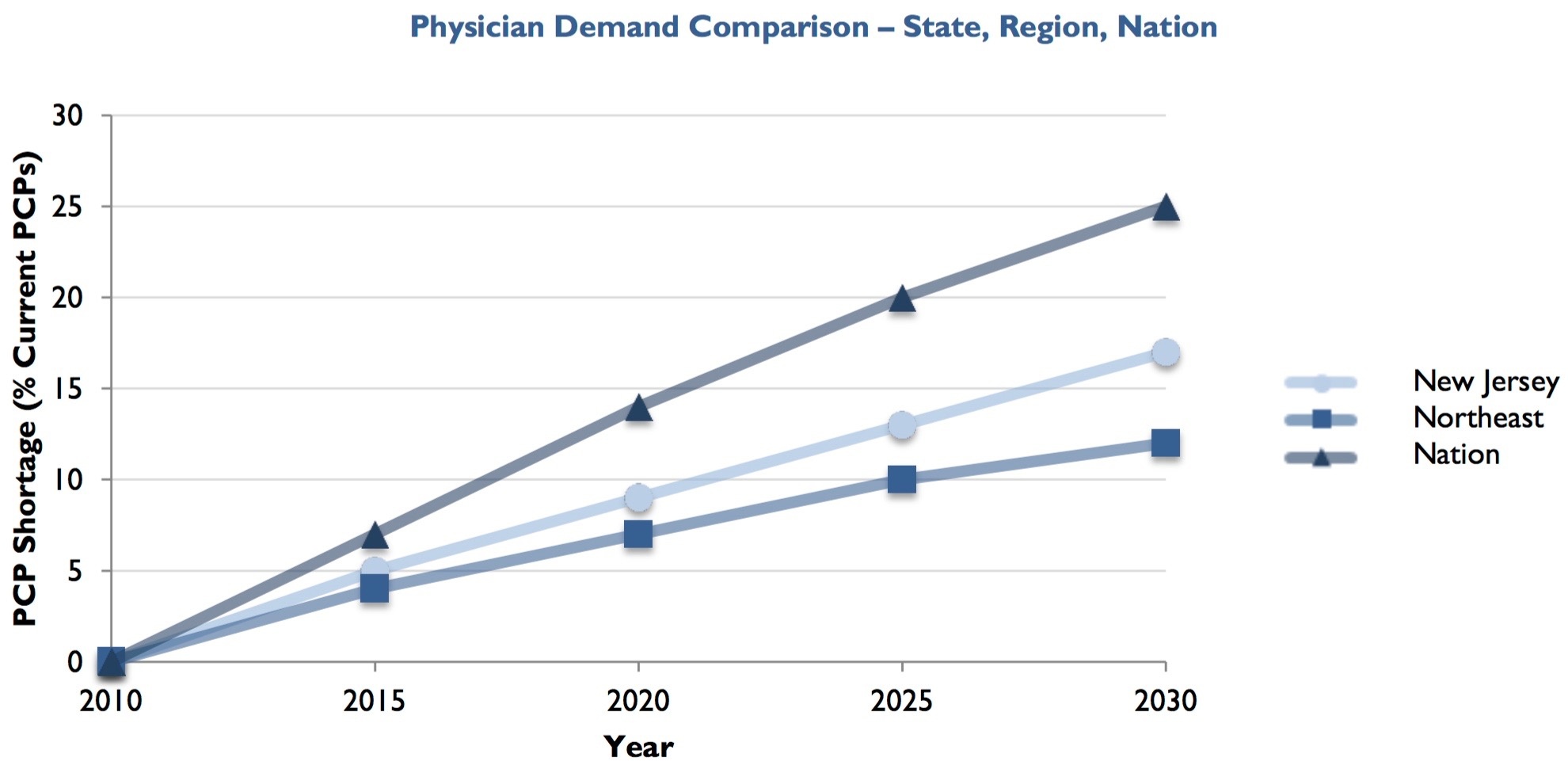
Currently, the demand for primary care physicians in New Jersey is higher than the demand in the Northeast but lower than the demand in the U.S. overall. In the previous blog post I wrote how Pennsylvania will need an additional 1,039 primary care physicians by 2030, which is an 11% increase compared to the state’s current workforce. New Jersey, on the other hand, will need an additional 1,116 primary care physicians by 2030, which is a 17% increase compared to the state's current workforce. Primary care physicians, as evidenced by the graph below, will be in higher demand in New Jersey than in Pennsylvania for the upcoming years.
Pressures from a growing, aging, increasingly insured population call on New Jersey to address the growing demand for primary care physicians to adequately meet health care needs.
The graph below shows the increased demand for primary care physicians by 2030 due to three factors: an aging population, a growing population, and the pressures felt from an increasing number of insured Americans due to the Affordable Care Act.
By 2020, with the number of older and insured Americans increasing, there will be a demand for 611 additional primary care physicians in New Jersey. By 2030, the number will nearly double, creating a demand for an additional 1,116 primary care physicians.
Why is the demand for primary care physicians outpacing supply? Find out here.
The Solution
To solve this primary care crisis in the United States, doctors and patients are switching to an alternative model that completely eliminates insurance and therefore, all of the problems associated with the traditional primary care payment model. This new model is called direct primary care.
Direct Primary Care
In this alternative model, patients pay their doctor directly, rather than through their insurance company. This means that patients pay a pre-defined monthly fee directly to their doctor instead of paying insurance premiums and co-pays. Basically, direct primary care cuts out the middle man and ultimately saves patients money. The cost of care is reduced to the point where the average American can once again afford to see a physician on a regular basis. Insurance isn’t necessary within this relationship because the care is affordable. Actually, keeping insurance out is what makes this relationship functional and affordable.
A new health care model is growing in popularity across the country. Frustrated by insurance complexities, endless paperwork and limited face-to-face time with patients, physicians are abandoning the traditional primary care model for a newer, more direct form of primary care. It's called direct primary care and it has the potential to significantly improve and possibly save modern health care.
Direct primary care completely abandons insurance billing, which has caused unnecessary agony amongst all primary care physicians. In replacement of insurance, patients pay a pre-set monthly fee regardless of the number of monthly visits or other encounters the patient has with the physician.
Are you looking for a doctor who suits your personal health needs? Finding the right doctor isn't easy. When you put your life in someone else's hands, you need to feel confident that this doctor has enough smarts, qualifications, and skills to give you the care you deserve. And besides, you could be starting one of the most important professional relationships you ever have.
Doctors practice in an environment where treating patients with insensitivity and impatience has become the norm, and they are forced to spend an hour per day on insurance paperwork. According to the Wall Street Journal article titled, "Why Doctors Are Sick of Their Profession," there is a growing discontent among physicians due to insurance and administrative overhead causing rushed visits and ultimately, a growing number of dissatisfied patients. As doctor and patient dissatisfaction escalates, satisfaction within American health care system slowly deteriorates.
Copyright © 2026 Total Access Medical, All Rights Reserved.
Built by Bumblebee Media
Disclaimer | Privacy Policy